
Nearsightedness, or myopia, as it is medically termed, is a vision condition in which people can see close objects clearly, but objects farther away appear blurred. People with myopia can have difficulty clearly seeing a movie or TV screen or the whiteboard in school.
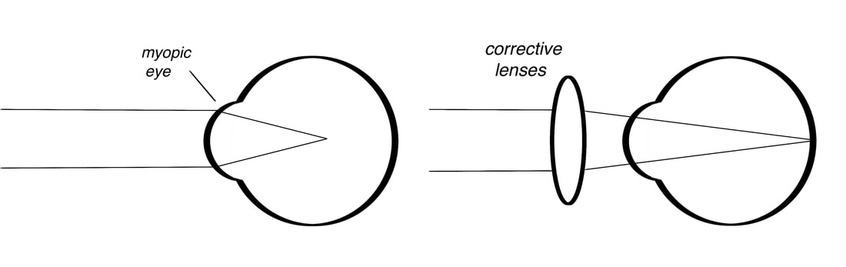
Myopia occurs if the eyeball is too long or the cornea (the clear front cover of the eye) is too curved. As a result, the light entering the eye isn't focused correctly, and distant objects look blurred.
Myopia affects nearly 30 percent of the U.S. population. While the exact cause of myopia is unknown, there is significant evidence that many people inherit myopia, or at least the tendency to develop myopia. If one or both parents are nearsighted, there is an increased chance their children will be nearsighted.
Even though the tendency to develop myopia may be inherited, its actual development may be affected by how a person uses his or her eyes. Individuals who spend considerable time reading, working at a computer, or doing other intense close visual work may be more likely to develop myopia.
Generally, myopia first occurs in school-age children. Because the eye continues to grow during childhood, it typically progresses until about age 20. However, myopia may also develop in adults due to visual stress or health conditions such as diabetes.
Myopia may also occur due to environmental factors or other health problems:
An optometrist can determine the cause of the vision problems through a comprehensive eye exam.
Copyrighted information courtesy of the American Optometric Association
Myopia affects nearly 30 percent of the U.S. population. While the exact cause of myopia is unknown, there is significant evidence that many people inherit myopia, or at least the tendency to develop myopia. If one or both parents are nearsighted, there is an increased chance their children will be nearsighted.
Even though the tendency to develop myopia may be inherited, its actual development may be affected by how a person uses his or her eyes. Individuals who spend considerable time reading, working at a computer, or doing other intense close visual work may be more likely to develop myopia.
Generally, myopia first occurs in school-age children. Because the eye continues to grow during childhood, it typically progresses until about age 20. However, myopia may also develop in adults due to visual stress or health conditions such as diabetes.
Myopia may also occur due to environmental factors or other health problems:
- Some people may experience blurred distance vision only at night. With "night myopia," low light makes it difficult for the eyes to focus properly. Or the increased pupil size during dark conditions allows more peripheral, unfocused light rays to enter the eye.
- People who do an excessive amount of near-vision work may experience a false or "pseudo" myopia. Their blurred distance vision is caused by overuse of the eyes' focusing mechanism. After long periods of near work, their eyes are unable to refocus to see clearly in the distance. Clear distance vision usually returns after resting the eyes. However, constant visual stress may lead to a permanent reduction in distance vision over time.
- Symptoms of myopia may also be a sign of variations in blood sugar levels in people with diabetes or may be an early indication of a developing cataract.
An optometrist can determine the cause of the vision problems through a comprehensive eye exam.
Copyrighted information courtesy of the American Optometric Association